Build what makes the product different
Start past the recurring setup. Put your attention into the workflows, experience, and details that make each product worth building.
Start with a SaaS foundation that gives your AI agent clear rules, a place for every feature, and working patterns to follow - so the code stays understandable as your product grows.
Building with AI. Staying in control.
Use it with your favourite AI agent:
 Cursor
 Claude
 GitHub Copilot
 Gemini
 ChatGPT
 WindsurfCursorClaudeGitHub CopilotGeminiChatGPTWindsurfCursorClaudeGitHub CopilotGeminiChatGPTWindsurfCursorClaudeGitHub CopilotGeminiChatGPTWindsurf
Why the foundation matters
From a blank repository, every prompt can choose a different place for features, a different way to connect payments and data, and a different pattern to repeat. Frontend Accelerator gives your agent the rules and working examples first.
Starting from scratch
Starting with Frontend Accelerator
The goal is not less AI. It is better context for AI.
A reusable way to build
Use the same structured starting point across client MVPs and SaaS products. Your agent follows the same rules while you focus on what makes each product different.
Start past the recurring setup. Put your attention into the workflows, experience, and details that make each product worth building.
Give Cursor, Claude Code, Copilot, Windsurf, and other agents the same rules, examples, and place for every feature.
Keep the complete TypeScript source inside a structure you can review, explain, and pass to the next developer.
How the foundation works
Every coding agent starts with the same project rules and working examples. Features have a clear home, reusable Skills guide common work, and provider code stays separate from the product built on top.
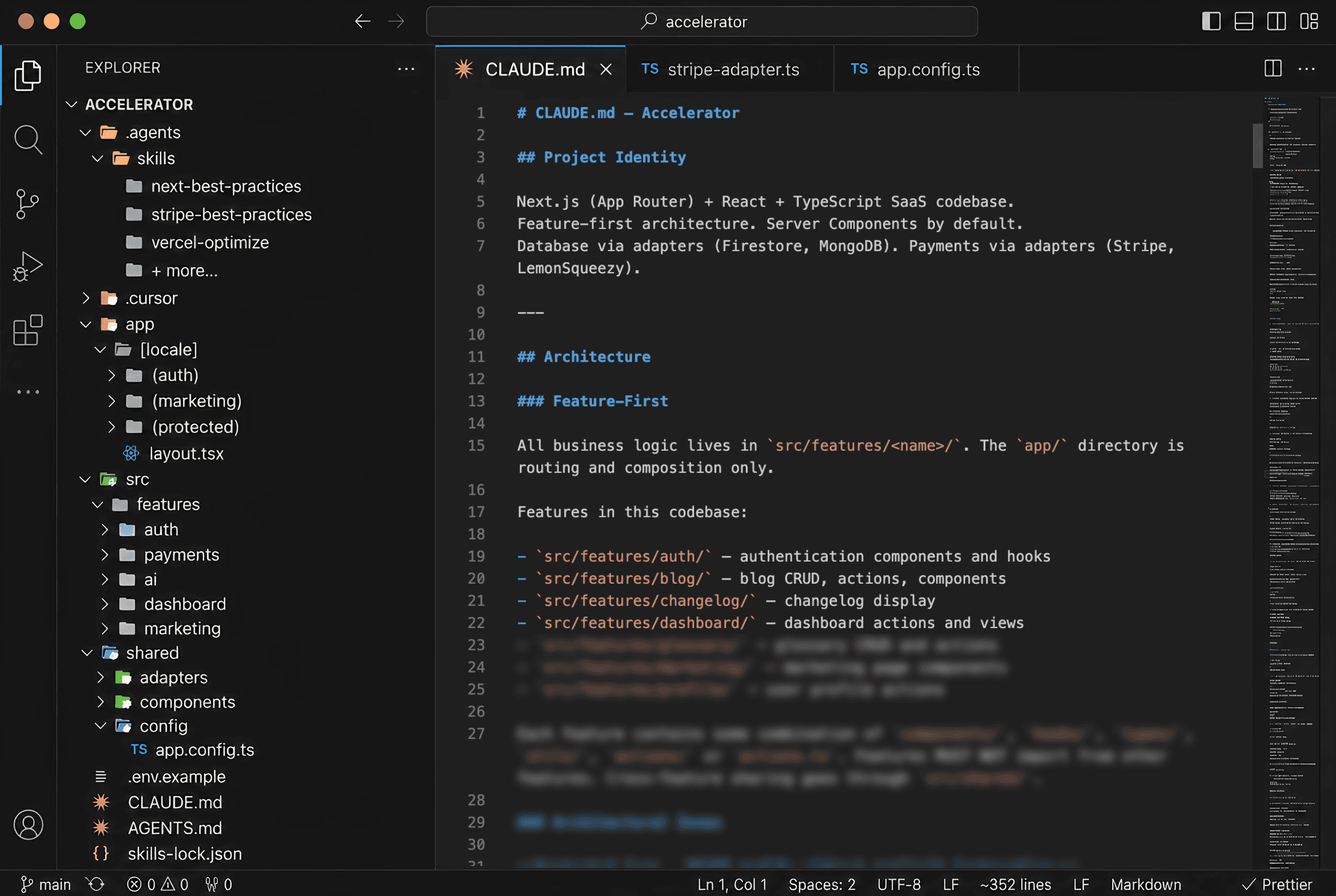
AGENTS.md
Cursor, Claude Code, Copilot, and Windsurf start from the same instructions and checks.
.agents/skills/
Agents can load repo-local guidance for Next.js, Stripe, testing, accessibility, and other recurring work.
src/features/<feature>/
New product behavior has a known place instead of spreading through whichever file was convenient.
src/lib/**/adapters/
Provider code stays away from the product features that use it, so changes are easier to trace.
The recurring work
These are not the whole product. They are a working example of how the structure fits together—and a head start you do not have to rebuild for each new project.
Google, GitHub, Facebook, and email magic links
Stripe or Lemon Squeezy, including payment webhooks
Choose Firestore or MongoDB while provider code stays separate
Admin and member access with protected admin routes
Working profile, product, user, and content areas
Blog, glossary, metadata, related content, and sitemaps
Ready for multiple languages
SMTP support for sign-in and application email
Responsive marketing, sign-in, and dashboard components
From purchase to product work
Frontend Accelerator gives you the starting point. You stay responsible for the product and what ships.
Clone the complete TypeScript source and begin from a working project instead of another blank repository.
Configure Firestore or MongoDB, Stripe or Lemon Squeezy, sign-in methods, email, and your product plans.
Give it the project rules, then use it for the routes, workflows, and product behavior your users actually need.
Review what ships, test the customer and payment flows, then launch, start charging, and improve the product from real feedback.
What customers noticed
“This is a fantastic and well-built Next.js boilerplate that makes launching new projects fast and hassle-free. Huge shoutout to Tomas for not only building such a well-structured and efficient setup but also for his support and taking the time to answer my technical questions.”

“The authentication and payment setup has also been a huge time-saver—it just works right after small configurations. On top of that, the folder structure is also easy to understand, which made it super quick to get onboarded.”

“Was having some hiccups around integration setup (payments and login). Tomas was willing to hop on a zoom call and work through the issues 1:1! It's a great start for individuals or companies looking to get started with a SaaS.”
“As a designer possessing beginner-level fullstack skills, the Frontend Accelerator has taken much of the upfront labor in both tech stack research and coding knowledge needed … saving me hours of time so that I can get right to the important and rewarding work, designing SaaS apps.”
“Frontend Accelerator is incredibly fast, intuitive, and easy to use. It has saved me so much time with its clean interface and efficient workflow. The features are powerful yet simple.”

“A great Swiss knife rich in options to start with a Next.js project.”

Tomas Mikula
Creator of Frontend Accelerator
Tomas Mikula
Developer and creator of Frontend Accelerator
I built Frontend Accelerator because every new SaaS project kept repeating the same infrastructure and architecture decisions. The idea is simple: start from a foundation that already works together, give AI clear boundaries, and spend your time building the actual product. You ship faster, make fewer structural mistakes, and end up with a codebase that’s still easy to review, maintain, and hand over.
Is it for you?
Use AI to build the product on top of a structured foundation with clear boundaries, reusable infrastructure, and rules your agents can follow.
Choose how you want to start
Start with the private source and use it as the working structure for your SaaS. Choose Guided Launch when you want direct help setting it up for your project.
Start every SaaS from the same structured foundation.




Start with the codebase, then work through the setup and your AI workflow with direct guidance.
Send your project context first. This is a request, not an automatic booking.
support@frontendaccelerator.com · I respond to every email.
Build what makes the product different without asking your agent to reinvent the foundation first. You keep the complete source, review the changes, and decide what ships.